IPSec
-
IPsec is a standard for the secure transmission of IP packets over insecure networks.
-
There are two protocols:
- Authentication Header (AH): Ensures the integrity/authenticity of the payload and (part of) the header data.
- Encapsulating Security Payload (ESP): Ensures the confidentiality and/or the authenticity of the payload.
-
There are two modes of operation:
- Transport: AH or ESP directly applied to the original IP packet
- Tunnel: Original IP packet is put into new IP packet which is then protected.
-
Often used for:
- Site-to-Site VPN connections, e.g. corporate networks
- Remote Access VPN
-
IKEv2 for key exchange and authentication
- Security Associations contain information necessary to do IPsec communication
- IKEv2 supports NAT-T
-
IPsec is a collection of protocols that allow secure communication over IP networks:
- RFC 4301 Security Architecture for the Internet Protocol
- Defines basic architecture and requirements for IPsec gateways.
- In particular: Security Associations Management
- e.g. “MUST support ESP”
- e.g. “MAY support AH”
- RFC 4302 Authentication Header (AH)
- Protocol to protect the integrity/authenticity of both payload and header data
- RFC 4303 Encapsulating Security Payload (ESP)
- Protocol to protect the confidentiality and integrity/authenticity of payload data
- RFC 7296 Internet Key Exchange v2 (IKEv2)
- Protocol for manual and automated key exchange
- Relevant for creating Security Associations used in AH and ESP
- RFC 4308 Crypto Suites for IPsec
- RFC 4309 Using AES CCM with IPsec ESP
- RFC 4106 Use of GCM in IPsec ESP
- RFC 8247 Algorithm Implementation Requirements and Usage Guidance for IKEv2
- RFC 8221 Cryptographic Algorithm Implementation Requirements and Usage Guidance for ESP and AH
- …
- RFC 4301 Security Architecture for the Internet Protocol
-
NIST Guide to IPsec VPNs: https://doi.org/10.6028/NIST.SP.800-77r1
Authentication Header (AH)

- Protects the integrity/authenticity of
- the payload
- and parts of the IP Header:
- Protocol Field in the IP header: 0x33
- Provides (optional) replay protection
- Does NOT provide confidentiality
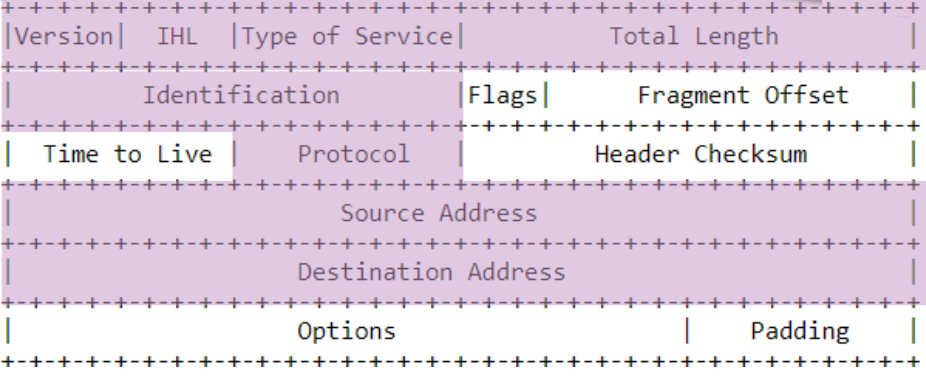
Authentication Header:
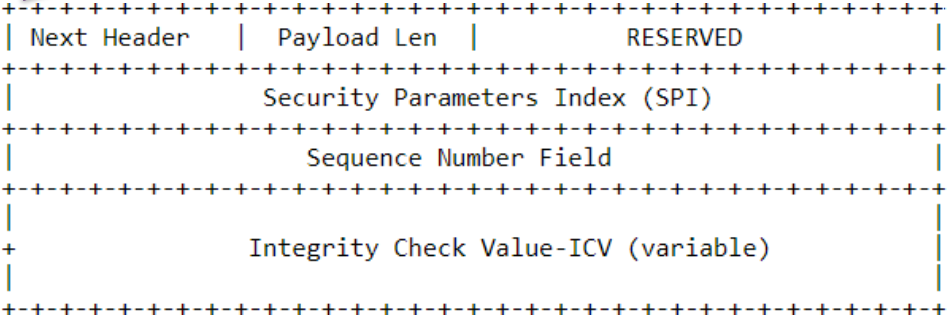
- Next Header: ID of the protocol of the payload
- e.g., TCP or UDP
- RESERVED: “zero”
- SPI: Identifies the Security Association (SA)
- SA defines security attributes
- Authentication algorithms
- Keys
- SA defines security attributes
- Sequence Number: for replay protection
- ICV: Integrity Check Value
- e.g. HMAC_SHA2_512_256
Replay Protection
- The sender increments the sequence number by one for every packet sent.
- The receiver stores the highest sequence number received so far.
- Too old or already received packets are rejected
- “Too old” is defined via the anti-replay window (default: 64)
- ⇒ Keep the newest (and thus highest) 64 sequence numbers
- The sequence number
- is tracked per security association (SA)
- is a 32-bit value
- max packets can be sent per SA
- Periodically a new SA is built
- Extended Sequence Numbering
- 64-bit values
- Used for high-speed connections (>100 Gbps)
Encapsulating Security Payload (ESP)
- Provides
- Confidentiality and authenticity of the payload
- Authenticity (via ICV) is optional (but recommended!)
- Optional replay protection
- Confidentiality and authenticity of the payload
- The IP header is NOT protected
- Protocol Field in the IP header: 0x34

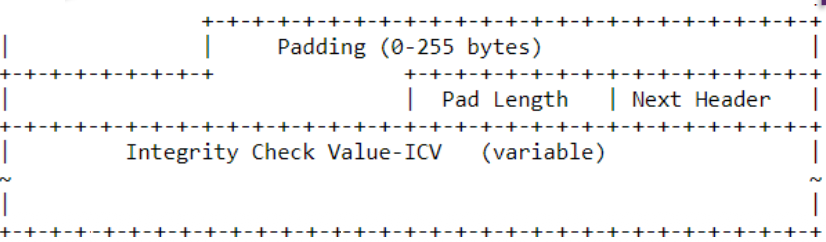
- ESP-Header:

- Sequence Number is for replay protection
- ESP-Trailer + ESP-ICV:
Modes of Operation
Both AH and ESP have two modes of operation:
- Transport Mode: Protects IP packets directly
- Tunnel Mode: IP packets are packed into a new IP packet (as payload) which is then protected
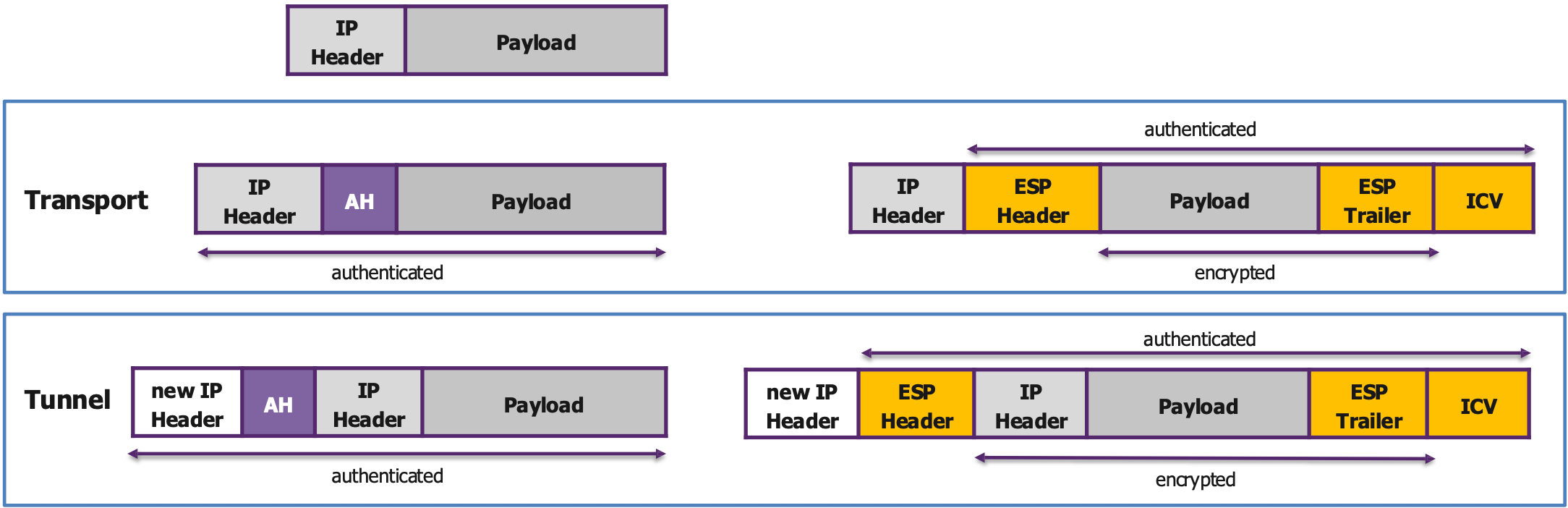
Transport Mode
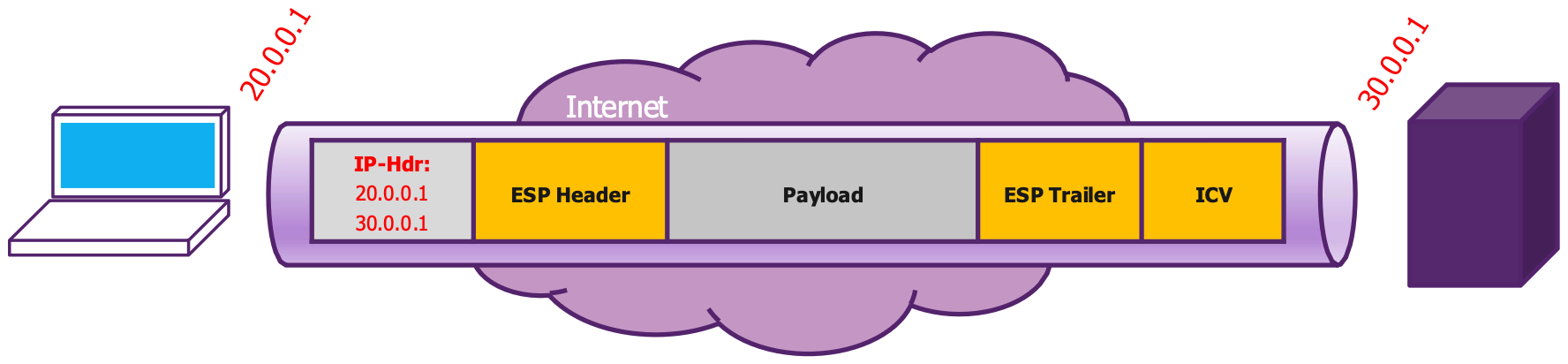
- The IP traffic is intended for the IPsec endpoints
- End-to-end security, but transparent for applications
- ESP: secure channel
- AH: authentic channel
Tunnel Mode
Site-to-Site VPN
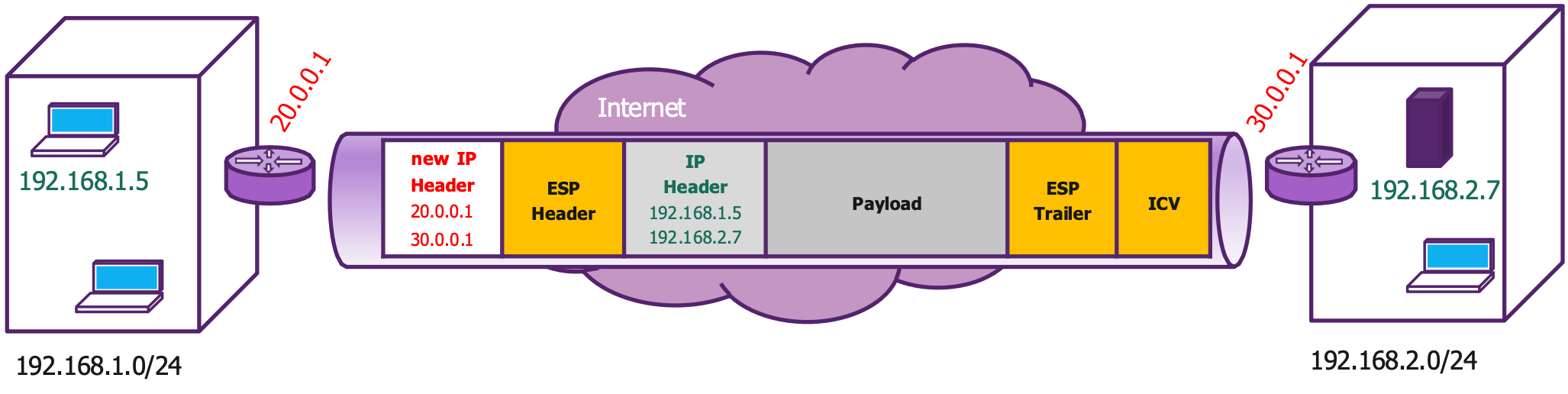
- Tunnel between two IPsec gateways
- Transparent for endpoints. Independent of application
- Internal IP addresses remain confidential
- VPN tunnel between corporate networks
Client-to-Site VPN
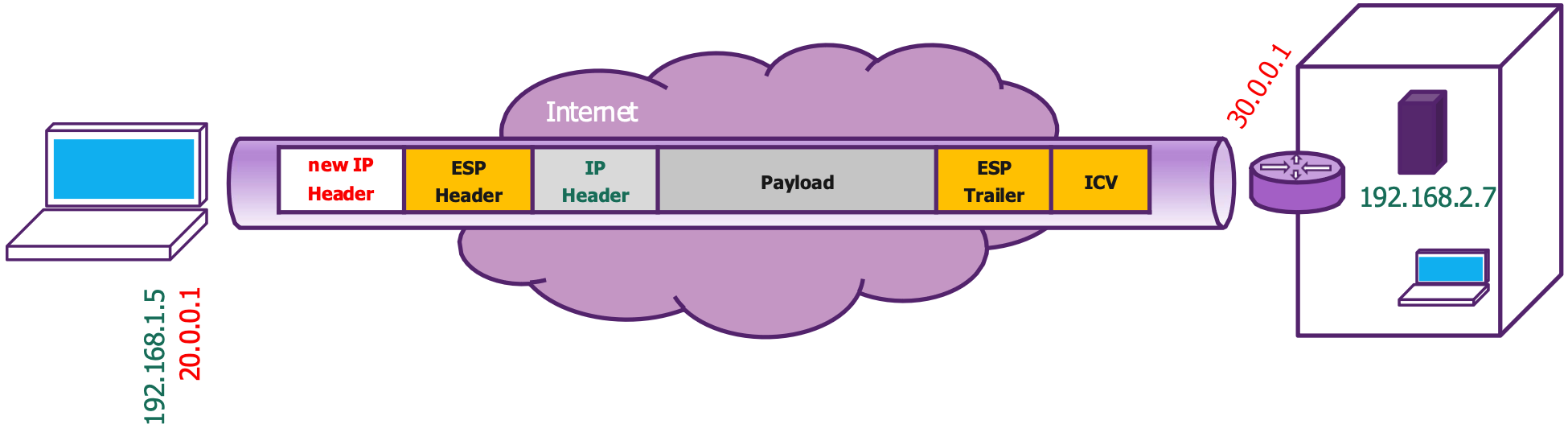
- Tunnel between an IPsec client and an IPsec gateway
- Internal IP addresses remain confidential
- Remote access to corporate network
Security Associations
- For IPsec communication the peers need to share information on
- Cipher Suite, Key Length, Keys, …
- Protocol: AH or ESP
- Mode (Transport or Tunnel)
- Sequence number counter
- Validity period of security associations
- This information is stored in a security association (SA):
- Identified by a Security Parameters Index (SPI)
- Separate SAs for each communication direction, i.e. one per sender
- Separate SAs for AH and ESP
SAD and SPD (Nominal mOdel)
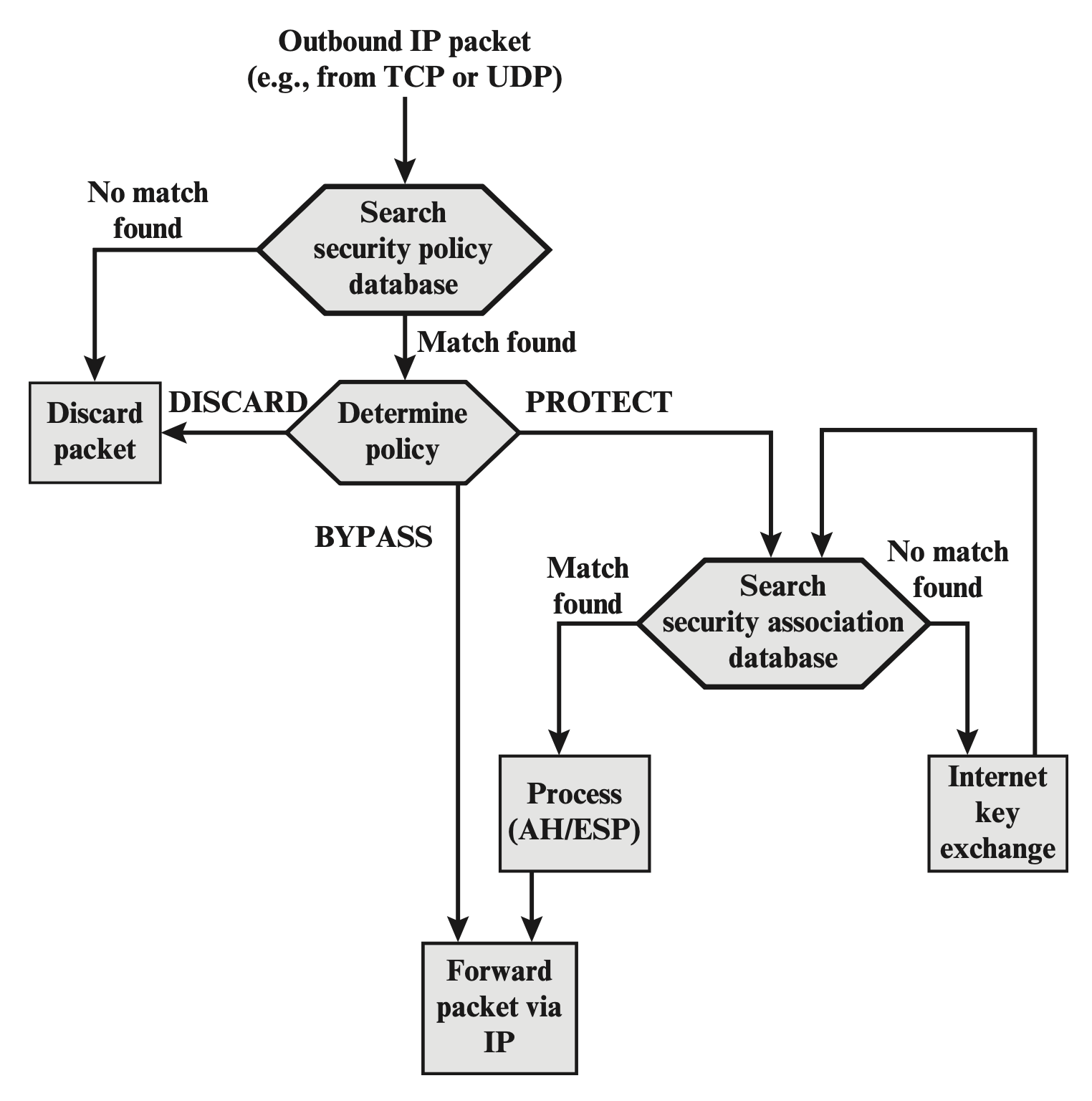
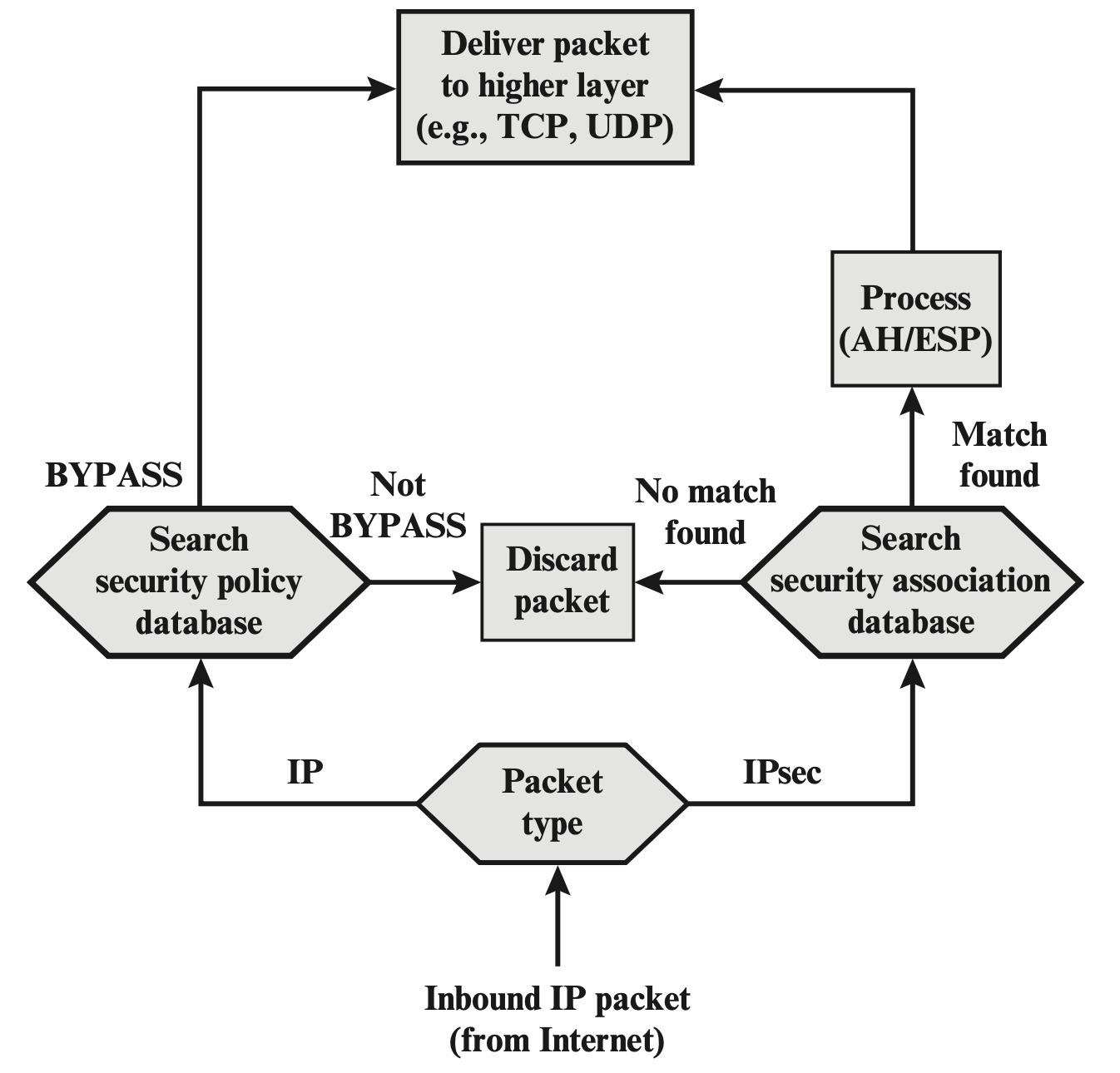
- Security Policy Database (SPD): decides how to handle an IP packet:
- Decision: Discard, Bypass, Protect
- based on selectors: IP addresses, Next Layer Protocol, …
- Security Association Database (SAD): holds all the security associations
- Incoming packets: SPI and possibly IP address point to SAD entry
- Outgoing packets: SPD entry points to SA

Handling of Outbound and Inbound Packets
Processing Model for Outbound Packets:
Processing Model for Inbound Packets:
Host SPD Example:
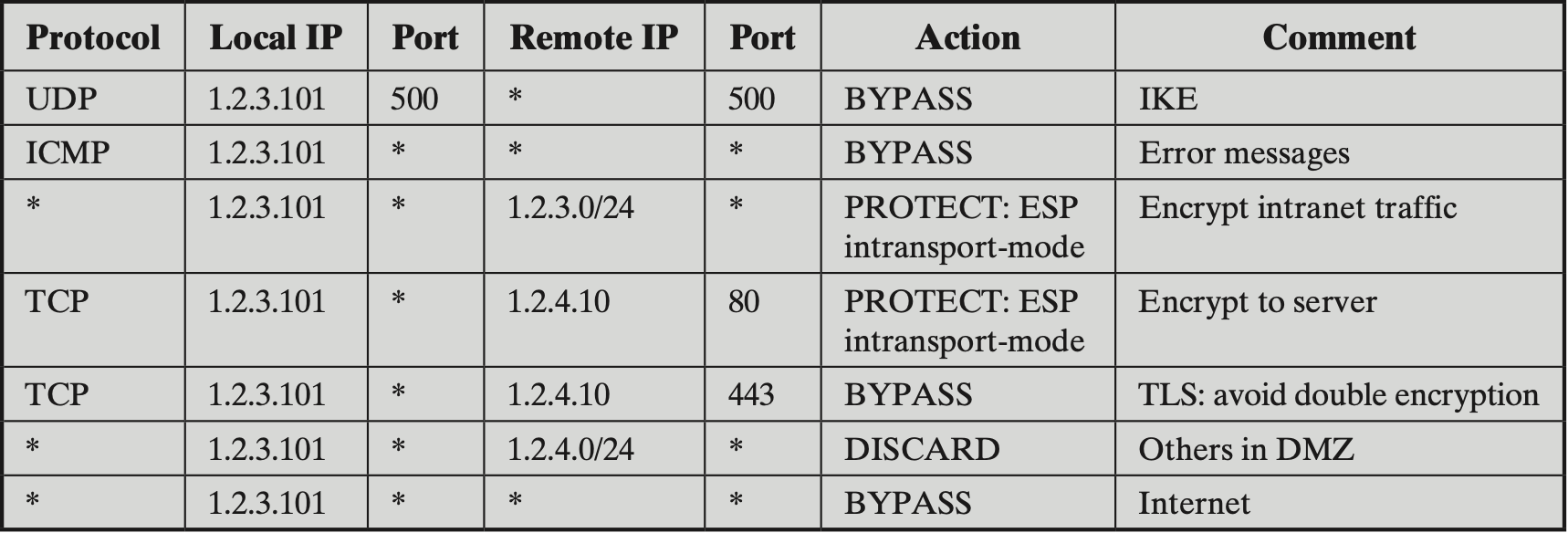
Source: “Network Security Essentials by William Stallings”
Internet Key Exchange V2 (IKEv2)
-
Internet Key Exchange (RFC 7296)
-
Protocol for mutual authentication (⇒ authenticates both peers) and building of security associations
- Between an Initiator and a Responder
- Goal: Initiator and Responder each have
- a security association for IKE transport (IKE-SA)
- security associations for ESP or AH traffic (CHILD-SA)
-
Establishes an IKE-SA including key material which allows establishing SAs for AH or ESP.
-
Communication consists of request-response message pairs.
- The first two messages (IKE_SA_INIT)
- negotiate the security parameters
- do a DH key exchange
- The second pair of messages (IKE_AUTH)
- verifies the identities
- establishes a first CHILD_SA
- The first two messages (IKE_SA_INIT)
-
The peers announce their IP addresses (via traffic selectors)
-
Messages are transmitted over UDP (port 500)
Phases
Initial Exchanges
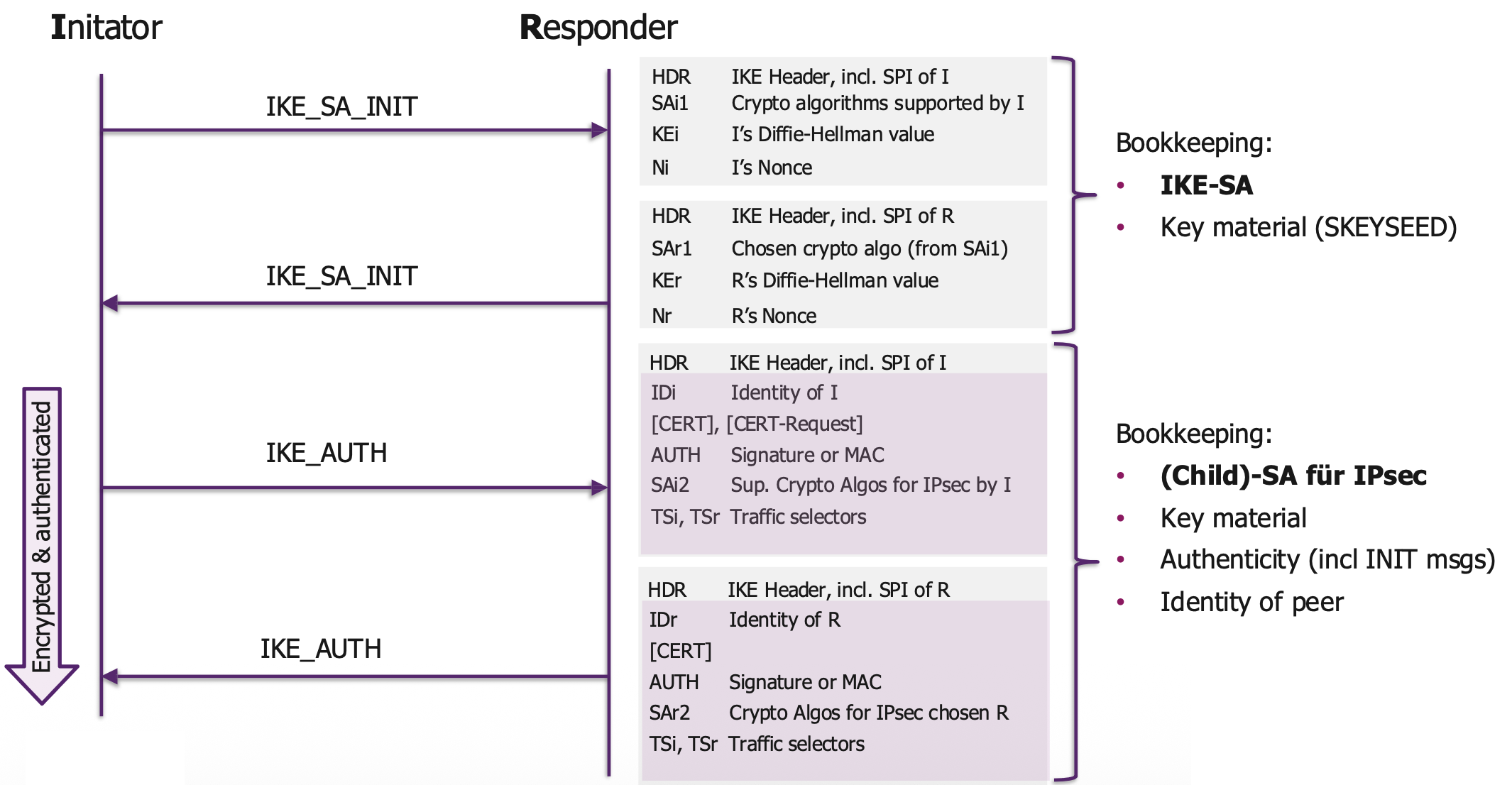
In the IKE_AUTH messages:
- The identity of peers is verified by means of
- Signatures
- Certificates are sent in the messages
- Symmetric MAC if using a pre-shared-key
- Signatures
- The authenticity of the IKE_INIT messages is verified as well
- Instead of AUTH one can use Extensible Authentication (EAP)
- Initiator omits the AUTH field to indicate this mode
- Normally used to authenticate an initiator
- Uses an additional exchange IKE_AUTH messages
Child SA Exchange
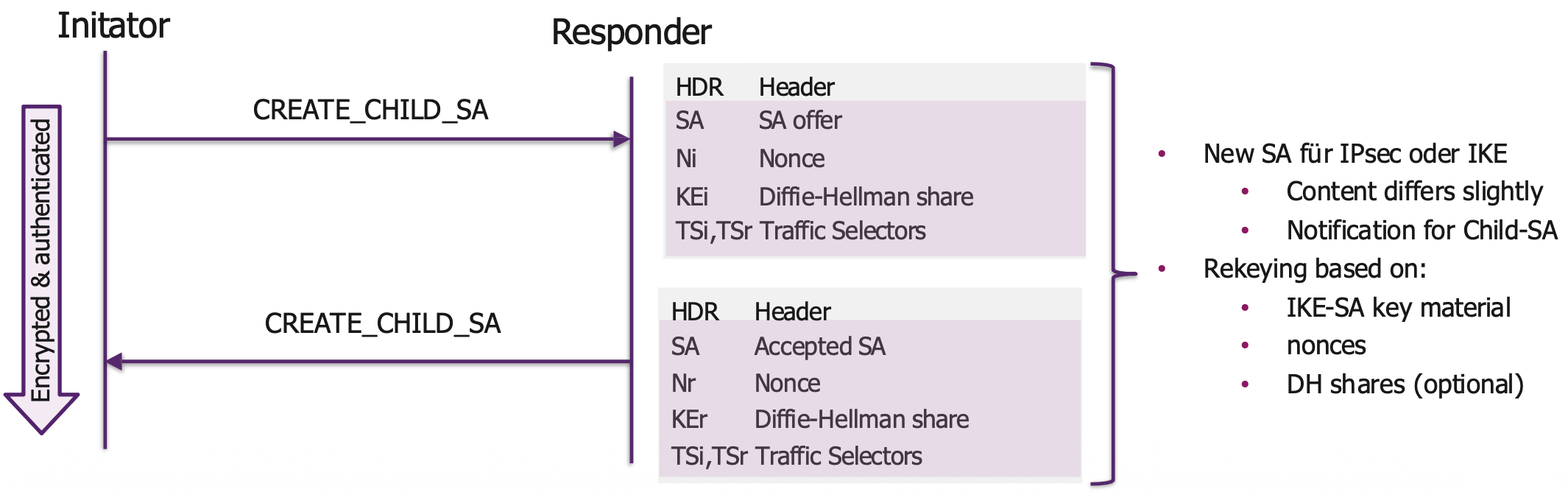
- Either:
- New Child-SA
- Rekeying of a Child-SA
- Rekeying of the IKE-SA
- Based on existing key material, optionally rekeying using DH
INFORMATIONAL
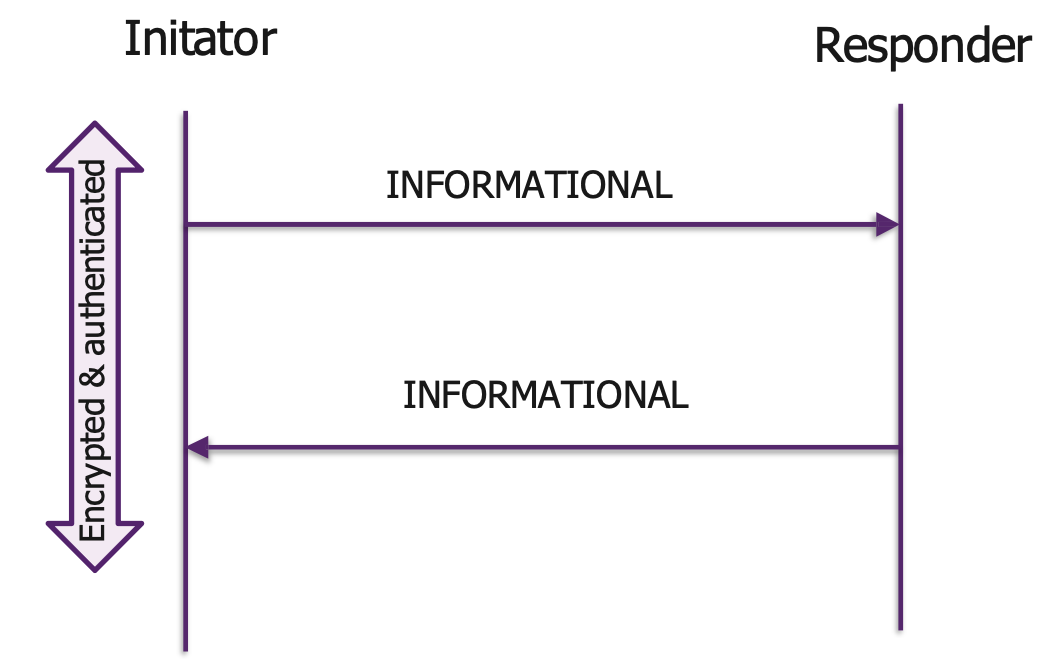
- Control messages, e.g. error messages, event notification
- Deletion of SAs
Key Derivation
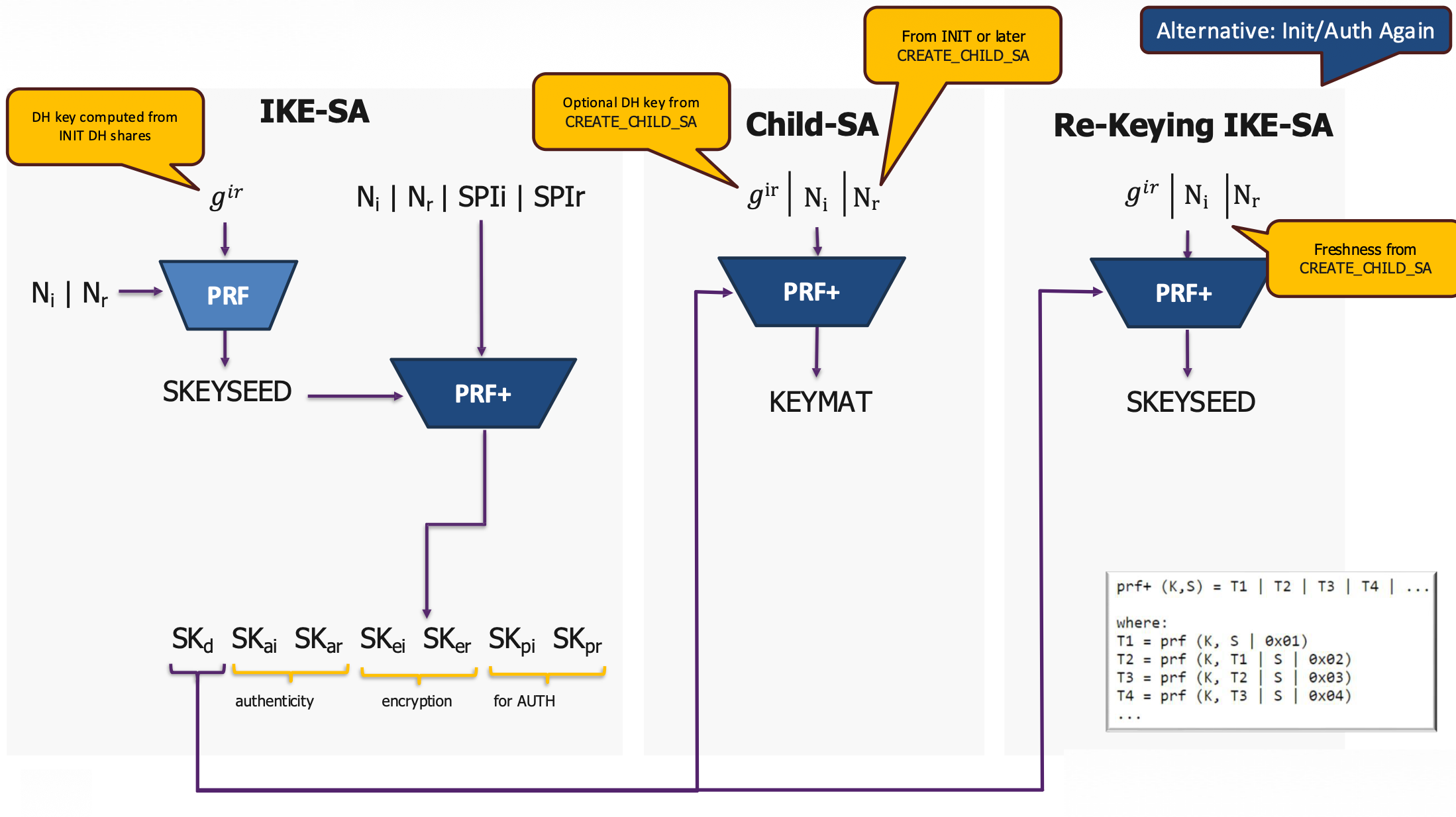
- IKEv2 uses a PRF (pseudorandom function) to derive key material
- PRF depends on cipher suite
- e.g. AES-CMAC
- PRF depends on cipher suite
- Inputs to the PRF comes from
- Existing key material
- Nonce
- DH key exchange (ephemeral key)
Key Material
Algorithms
- IPsec use various cryptographic algorithms (in IKEv2 negotiated (SAs)).
- RFC 8247 specifies “mandatory-to-implement” algorithms für IKEv2
- RFC 8221 specifies algorithms for AH and
- Various RFCs defines cipher suites with the goal of interoperability and a certain level of security
- RFC 4308: Cryptographic Suites for IPsec (2005)
- VPN-A - commonly used
- VPN-B - expected
- RFC 6379: (NSA) Suite B Cryptographic Suites for IPsec (2011)
- RFC 4308: Cryptographic Suites for IPsec (2005)
- Technische Richtlinie TR-02102-3 (BSI)
- NIST SP
Logjam
- Attack on DH key exchange (MitM)
- Many systems use the same primes (aka integer groups) to do DH.
- Attacker can do some pre-computation to speed up computation of discrete logarithms in a fixed group.
- 2015 estimate: Precomputation cost for 1024bit DH group: ~100M $
- Many systems use the same primes (aka integer groups) to do DH.
- Problem for protocols such as IKE
- Solution: Use larger integer groups or elliptic curves.
IPsec & NAT
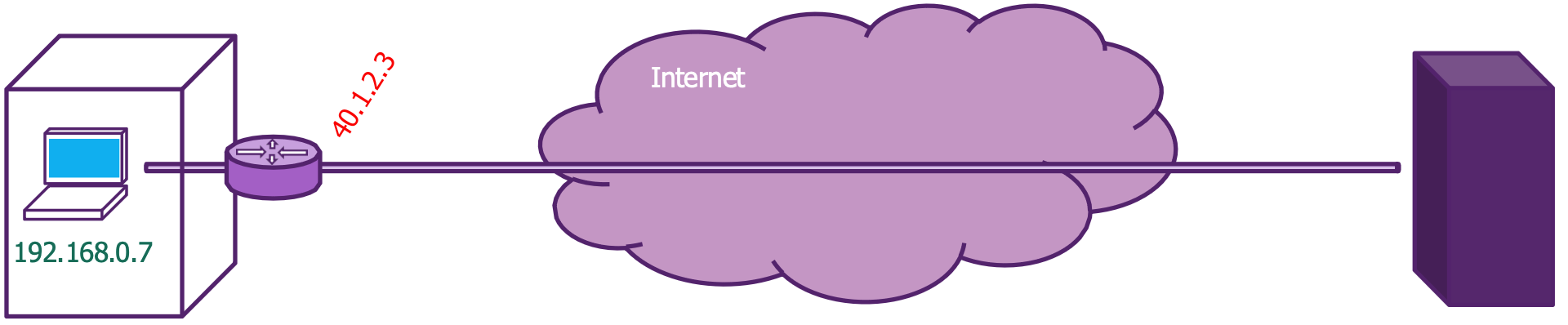
- Scenario: Client-to-Site VPN
- E.g. from home or from a hotel
- Client has no public IP, is behind a NAT
NAT Variants
- One-to-one NAT. The NAT:
- replaces source address with its public address
- only works with one client
- Port Address Translation (PAT). The NAT:
- replaces source address with its public address
- Replaces (UDP/TCP) source port with unique free port
- Relays incoming packets to the right client based on the port number.
NAT Problems with IPsec
- Problems with ESP
- PAT: The payload (UDP/TCP) is encrypted and cannot be changed by the NAT
- One-to-One NAT: TCP (and UDP in IPv6) has checksums that break when swapping out IP
- AH incompatible as IP addresses are authenticated
- Problems with IKE
- Using IP addresses as an identifier (IKEv1) causes issues.
- IKE responder needs to accept packets from a non 500 port.
- And more (RFC 3715)
Solution: NAT-T
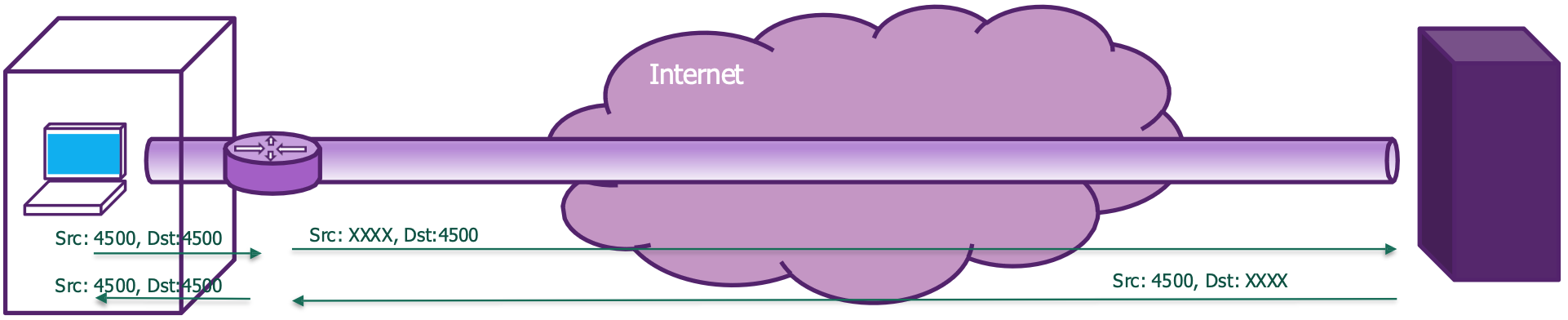
- RFC 3948: UDP-Encapsulation of IPsec ESP Packets

- UDP-Header between IP-Header and ESP-Header
- Source und destination port: 4500
- IKEv2 (RFC 4306) can (implementation optional)

- Detect NAT (NAT_DETECTION_SOURCE_IP and NAT_DETECTION_DESTINATION_IP in INIT-msg)
- Negotiate UDP-Encapsulation for IKE and ESP
- Source und dst. port: 4500, reply to arbitrary port
Other VPN Protocols
- SSL VPN
- Based on TLS
- Port 443 ⇒ less blocked
- Often implemented as application
- e.g. OpenVPN
- Mainly used for remote access
- Based on TLS
- WireGuard
- New, written for the Linux kernel
- Minimalist implementation
- Less complexity & less flexibility
- Secure Socket Tunneling Protocol (SSTP)
- Microsoft’s implementation of SSL VPN
- L2TP (Layer 2 Tunneling Protocol)
- L2 via L3 networks
- Offers no security on its own
- ⇒ combine it with IPsec
- PPTP (Point to Point Transport Protocol)
- Generic Routing Encapsulation
- unsafe crypto algorithms
Relevant Note(s):